


From the inauguration of ROSA, a new laboratory on cultural and botanical heritage mediation at the Rose Garden, to the hidden histories of enslaved people; from traces of the colonial past in public space to ethnobotany; from the mosque to the protagonists of anti-colonial resistance in Nigeria featured in the exhibition Black on White; from the songs of Afro-Pacific traditions to the political history of yoga: Uncomfortable Tours questions the cultural and symbolic legacies of colonial modernity and the ways in which they continue to operate in the present.
Uncomfortable Tours is a project by Accademia dell’Incompiuto, within the framework of the AMIR – Alliances, Museums, Encounters, Relations project, and ROSA, realised with the support of Estate Fiorentina 2026, an initiative included in the Operational Plan of the City of Florence.
The programme includes 25 free events, of which 5 are dedicated to summer centres, informal groups, volunteer organisations, and social promotion associations.
From 12 June to 30 September 2026.
*Based on an idea by Alice A. Procter (UK), www.theexhibitionist.org

PROGRAM
All visits are part of the AMIR | Alliances, Museums, Encounters and Relations project.
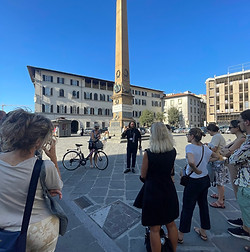
FIRENZE COLONIALE
City itinerary in Florence’s historic centre, meeting point at Piazza Adua.
In the “cradle of the Renaissance,” the city’s colonial past remains only faintly visible, yet streets, monuments, and commemorative plaques still recall often-forgotten enterprises and figures. From Piazza Adua, with its Rationalist architecture, to the obelisk in Piazza dell’Unità, where plaques celebrating the construction of the nation form a continuous narrative, and to the sculpture of Hercules strangling the lion, the traces of our colonial past—mostly overlooked or hidden—help tell the broader history of Italian colonialism in Eritrea, Somalia, Libya, Ethiopia, and Albania, territories subjected first to liberal governments and later to the Fascist regime between 1885 and 1941.
° Thanks are extended to Postcolonial Italy.
° In collaboration with The Recovery Plan.
° Special thanks for consultancy to Carmen Belmonte and Agnese Ghezzi.
12.06, h. 17
18.09, h. 17
JOHN LOUIS, BLACK ON WHITE*
From 17 June to 30 September 2026
ROSA, Rose Garden, Giardino delle Rose, Viale Giuseppe Poggi 2
John Louis, a young Nigerian artist, is self-taught in drawing, having learned while working as a barber in Awkuzu, in southern Nigeria. His artistic practice begins with photography and develops through pencil drawing, with a careful use of chiaroscuro. His interest in the history of his country led him to create a series of eight portraits dedicated to activists, musicians, and writers who took part in the resistance against colonialism in Nigeria.
17.06 Opening (vernissage) on the occasion of the inauguration of ROSA
26.06, 11.09 and 26.09 AMIR guided visits
The exhibition is also open by appointment by contacting the secretariat via email: amirmuseums@gmail.com

17.06*, h. 17.30
26.06, h. 18
JOHN LOUIS, BLACK ON WHITE*
From 17 June to 30 September 2026
ROSA, Rose Garden, Giardino delle Rose, Viale Giuseppe Poggi 2
John Louis, a young Nigerian artist, is self-taught in drawing, having learned while working as a barber in Awkuzu, in southern Nigeria. His artistic practice begins with photography and develops through pencil drawing, with a careful use of chiaroscuro. His interest in the history of his country led him to create a series of eight portraits dedicated to activists, musicians, and writers who took part in the resistance against colonialism in Nigeria.
17.06 Opening (vernissage) on the occasion of the inauguration of ROSA
26.06, 11.09 and 26.09 AMIR guided visits
The exhibition is also open by appointment by contacting the secretariat via email: amirmuseums@gmail.com

11.09, h. 18
26.09, h. 18
STORIE DI PIANTE E PERSONE IN VIAGGIO
Multi-voiced ethnobotanical walks
Visit to the Orto Botanico di Firenze, Via Micheli 3
Starting from the 16th century, plants from Asia, Africa, and the Americas began to populate the gardens of villas, greenhouses, and European botanical gardens. Generation after generation, a cultural and botanical heritage originating from other countries took root in Europe and in Florence, where it was catalogued and renamed according to an Enlightenment-based classification system.
In this process of adaptation, much information regarding the food, medicinal, and traditional uses of these plants—as well as their original names in native cultures—has been lost. The walk brings together the knowledge of mediators and curators, giving space both to the biological and ecological characteristics of the species and to their ethnobotanical uses, often unknown or overlooked.
°In collaboration with the Museum System of the University of Florence.

18.06, h. 17.30
02.07, h. 17.30
03.09, h. 16.30
24.09, h. 16.30

UNA NUOVA MOSCHEA A FIRENZE
Visit to the Mosque, Via dei Martiri del Popolo 39/R
In the Sant’Ambrogio district, there are three important places for the local community, which has long been actively engaged in promoting interreligious dialogue and mutual respect among the three main monotheistic religions. Here, between the green dome of the Synagogue and the historic Church of Sant’Ambrogio, the new mosque has recently been inaugurated as a place of worship and gathering for communal prayers, including a space for ablutions and an area reserved for women.
Although the building does not feature domes or minarets, it fully respects the organization and liturgy of Islamic worship, becoming a visible sign of the Florentine Muslim community, long rooted in the area.
°In collaboration with the Islamic Community of Florence.

23.06, h. 18
22.09, h. 18
MAPPE VEGETALI
Landscapes, knowledge, and memories
Visit to the Giardino delle Rose, Viale Giuseppe Poggi 2
Through an ethnobotanical and decolonial perspective, this visit explores the garden as a living archive that gathers traces of 19th-century plant collecting, as well as botanical and agricultural knowledge from Indigenous peoples, preserved and shared by AMIR mediators. The 1998 gift from the city of Kyoto—Florence’s sister city—of the garden named “Shorai” also opens a reflection on landscape as a space of relationship and botanical diplomacy.
*This visit will be conducted in intercomprehension, a communication methodology based on the use of one’s native language as a practice to counter glottophobia and promote respect and active listening to diverse cultural and linguistic identities.

25.06, h. 17.30
16.09, h. 17.30
23.09, h. 17.30*
PRESENZE NERE A FIRENZE
City itinerary in Florence’s historic centre, meeting point in front of Palazzo Medici Riccardi.
A route through the city centre exploring the traces of a lesser-known history: slavery in Renaissance Florence. The itinerary begins at the Medici Palace, where the Chapel of the Magi preserves a significant portrait, and continues with the account books of the Cambini Fund in the archives of the Istituto degli Innocenti, which document the arrival of enslaved people from Africa in the second half of the 15th century.
It concludes at the Chapel of Saint Joseph in the Church of the Santissima Annunziata, built in a scenic Baroque style by Francesco Feroni, who amassed his vast fortune through the Atlantic slave trade.
° Thanks are extended to the Metropolitan City of Florence and Justin Randolph Thompson with Black History Month Florence.

06.09, h. 11
INCONTRO SULL'ETNOPSICHIATRIA
Visit to the Giardino delle Rose, Viale Giuseppe Poggi 2
This meeting offers a reflection on ethnopsychiatry as a theoretical and methodological approach that critically examines the frameworks of Western clinical knowledge, opening a space for listening to subjectivities, memories, and traumas inscribed in histories of migration, racialization, and systemic violence.
It is an opportunity to rethink care as a situated relationship—shaped by cultural differences, power relations, and possibilities for transformation.
° Meeting curated by Afef Hagi, ethnopsychologist.

12.09, h. 10

CHI STA FUORI?
ROSA, Giardino delle Rose, Viale Giuseppe Poggi 2
A workshop on borders—physical, linguistic, symbolic, and cultural—as tools for constructing norms and defining otherness.
Through images, articles, documents, and historical narratives, the session analyses the processes through which societies and states produce binaries (normal/abnormal, citizen/enemy, centre/periphery) and define marginalised groups as threats, deviant bodies, or subjects to be assimilated, controlled, or rendered invisible.
° Workshop in collaboration with the students of the Academic Master’s programme in Transcultural Mediation of Heritage and the Contemporary, curated by MAD | Murate Art District.

17.09, h. 18
UNA STORIA POLITICA DELLO YOGA
ROSA, Giardino delle Rose, Viale Giuseppe Poggi 2
The workshop offers a space to understand the history of modern postural yoga and its relationship with contemporary practice. Through a critical and well-documented perspective, it explores how yoga as it is widely practiced in the West today is the result of a relatively recent historical construction, shaped between colonial India, Europe, and the United States. The aim is to encourage a more conscious approach to yoga, without renouncing its transformative dimension.
° Curated by Virginia Pisano, Ashtanga yoga teacher at the Yama school in Marseille, cultural worker and researcher.
*9:30 am: Ashtanga yoga session (dynamic yoga); 11:00 am: theoretical discussion

26.09, h. 9.30*
26.09, h. 11
CHI BALLA COSA? STORIA DI DANZE E CANTI AFRO-AMERINDI COLOMBIANI
A sung gathering dedicated to traditional repertoires from the Colombian Pacific and Caribbean coasts, reflecting on exotification, resistance, and cultural appropriation. Through collective singing and dialogue, the session proposes a more conscious engagement with these rhythms and the histories that run through them.
° Curated by Accademia dell’Incompiuto.
ROSA, Giardino delle Rose, Viale Giuseppe Poggi 2

30.09, h. 18
